Why You Keep Losing at Block Blast
Most players assume Block Blast comes down to luck. It doesn't. The difference between a game that ends in two minutes and one that breaks your high score is almost always the small, repeated decisions you make on every turn. The frustrating part is that bad habits don't end your game right away. They build quietly in the background until, a few moves later, the board is jammed and there's nowhere left to go.
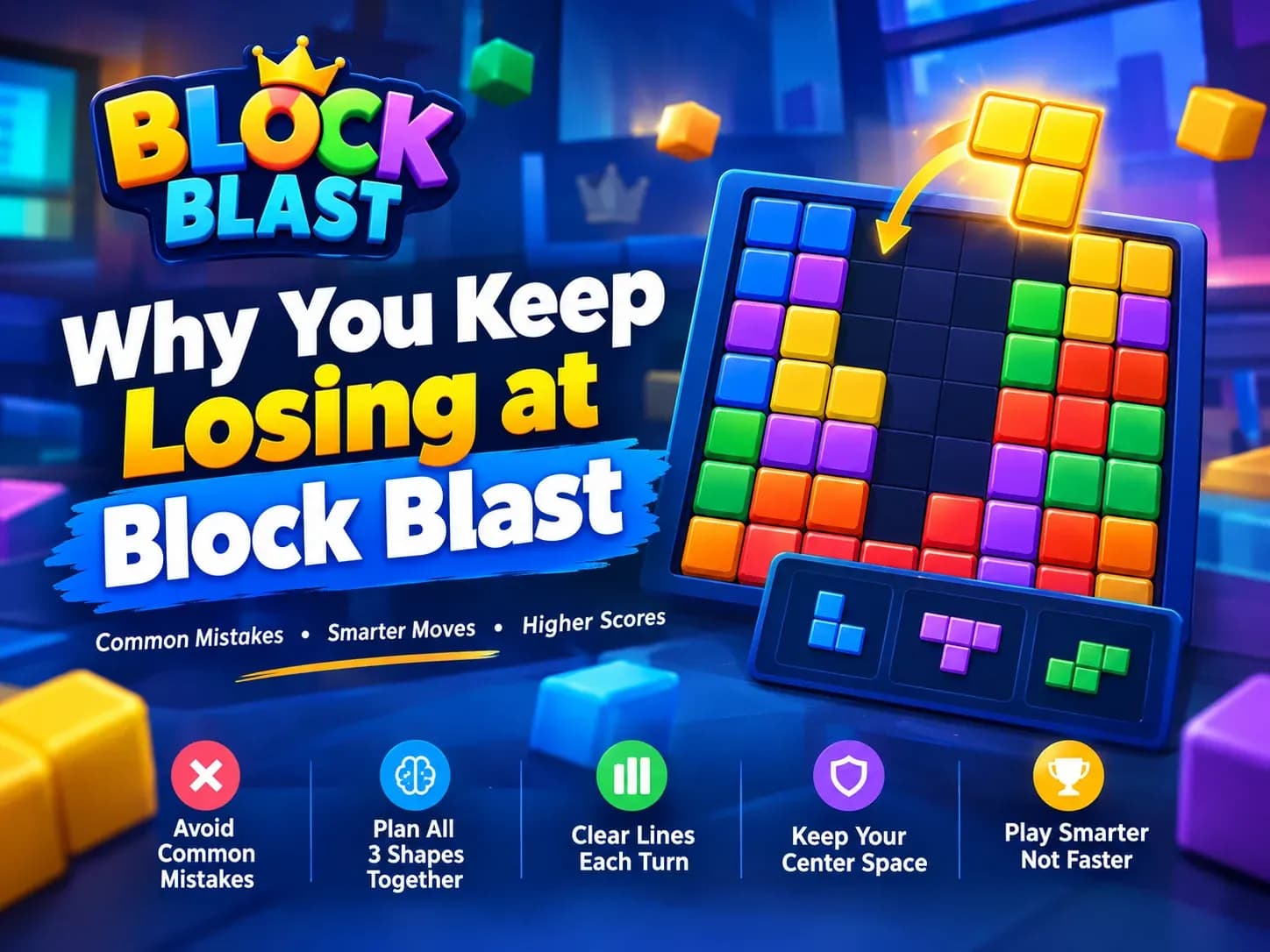
The Mistakes Quietly Ending Your Games
You place the first shape before checking the next two
This single habit ends more games than any other. It's tempting to drop the first piece that fits and figure out the rest later — but by then, the ideal spot for your second or third shape is often already taken. Block Blast shows you all three shapes at once on purpose. Treat them as one connected move, not three separate ones, and your board stays far easier to manage.
You keep the board too empty
An open board feels safe, but empty cells never score a point. Only completed rows and columns do. Many beginners spread their blocks out to avoid feeling boxed in, then wonder why their score hardly moves. The goal isn't a tidy board — it's a board that's constantly filling and clearing.
You fill the corners and edges first
Corners look like convenient parking spots for awkward pieces. In reality, they're where boards go to fill up. Blocks stacked along the edges are the hardest to clear and the quickest to trap you. Build from the center outward and keep your edges open for as long as you can.
You leave scattered single gaps
Placing shapes carelessly leaves behind lone empty cells surrounded by filled ones. These one-square holes are nearly impossible to fill and slowly strangle your available space. Aim to place every block flush against another so your open space stays in large, usable blocks.
You speed up when you should slow down
When space runs low, panic takes over and moves get sloppy exactly when precision matters most. The late game rewards patience, not speed. One rushed placement can undo an otherwise excellent run. If crowded boards are where your games usually fall apart, learning to escape a stuck board can help.
How to Start Playing Smarter
You don't need advanced tactics to improve — just a handful of better habits:
- Plan all three shapes as one move before placing anything.
- Build near-complete rows and columns so a single well-timed block clears them.
- Clear at least one line every turn to keep your combo streak and its bonus points alive.
- Guard the open space in the center for bulky pieces like the 3×3 square and long straight lines.
- Give every placement a purpose — if it doesn't set up a clear or preserve space, reconsider it.
Every one of these comes back to a single principle: planning beats reacting. Conscious play consistently outscores fast, impulsive play.
When a Solver Makes the Difference
Some boards become so twisted that finding the best move by eye is nearly impossible. That's where Block Blast Solver earns its place. Powered by Super Intelligence, it reads your entire board and all three upcoming shapes together, then maps out the placement sequence that clears the most lines while keeping your options open.
It's a strategy tool. By showing you the smartest move in the exact situations you'd normally misplay, it trains your eye to recognize better patterns and build the habits that lead to higher scores on your own.
Final Thought
Losing at Block Blast is rarely about luck, and almost always about approach. The moment you stop reacting to each shape and start planning several moves ahead, your board stays healthier and your scores climb naturally. Play with intention, protect your space, and lean on smart analysis whenever a board gets too tricky to solve alone.
Key Takeaways
- Small, unnoticed habits — not bad luck — are what quietly wreck your board.
- Chasing empty space and filling edges are two of the fastest routes to an early loss.
- Rushed placements under pressure end strong runs; slowing down late is what counts.
- Planning all three shapes together and clearing a line each turn keeps your score rising.
More Block Blast Guides
Ready to try it on your board?
Upload a screenshot and get the exact moves in seconds.
Open the Solver